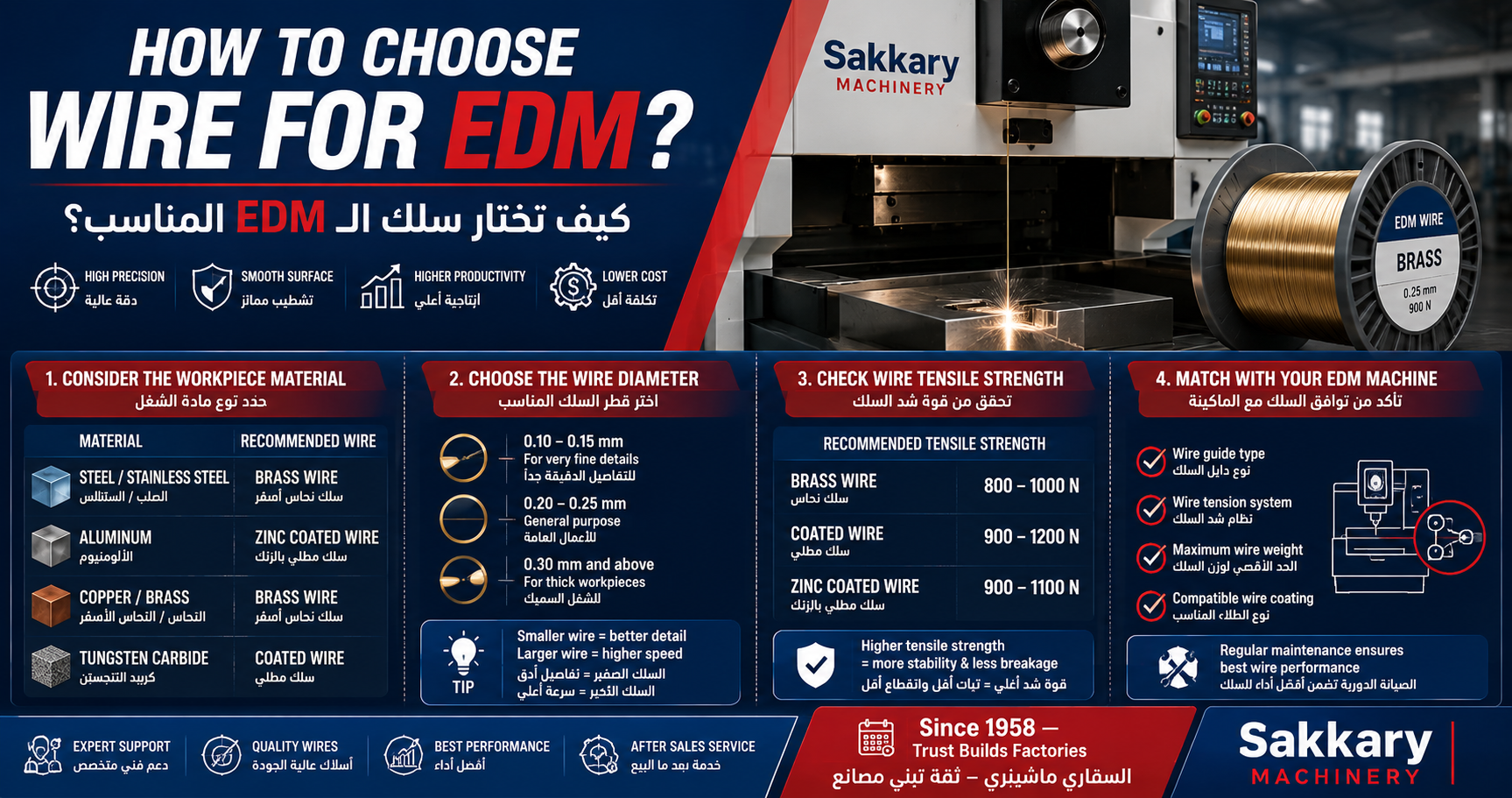
How to Choose Wire for EDM?
EDM Wire Properties & Types - Sakkary Machinery
EDM Wire Properties
Tensile Strength
Tensile strength is the maximum load-bearing capability of a material based on its resistance to stretching and breaking. It is calculated by dividing the maximum load (lbs/in²) by the wire’s cross-sectional area. High-tensile EDM wire provides better edge straightness, making it ideal for single-pass parts and small or fine-diameter wires to reduce wire breakage. It’s also preferred for cutting tall parts requiring straightness and break resistance. High-tensile wire aids in skim cuts for improved geometric accuracy.
Fracture Resistance
Fracture resistance, often referred to as wire toughness or resilience, describes the wire’s ability to withstand the highly dynamic environment within the spark gap. Wires with greater toughness perform better against repeated thermal and mechanical shocks during cutting.
Conductivity
Conductivity measures a material’s ability to carry electrical current. In EDM, higher conductivity allows greater power delivery to the workpiece, resulting in faster cutting speeds and increased efficiency.
Vaporization Temperature
Wires with lower melting or vaporization temperatures are best for flushing performance. The surface should vaporize quickly rather than forming resolidified chips that clog the spark gap. Zinc-coated wires aid in better flushing, while molybdenum or tungsten wires — with high vaporization points — cut slower but are ideal for precision skim cuts.
Hardness
Hardness refers to a wire’s ductility or ability to elongate. EDM wires are categorized as soft or hard. On closed-guide machines, hard wires provide better auto-threading reliability, whereas soft wires are better suited for taper cutting. Hard wires ensure superior threading consistency.
EDM Wire Types
1. Copper Wire
The first wire used for wire EDM. Its high conductivity made it ideal in early machines, but limited tensile strength and slower cutting speeds make it less common in modern systems. Today, copper wire is mainly used in older machines that require it.
2. Brass Wire
Brass wire, made by adding zinc to copper, is the most common EDM wire type. Zinc lowers the melting point, improving cutting efficiency. With a Cu/Zn ratio of 63/37 to 65/35 and tensile strengths between 54,000–173,000 psi, brass wire is versatile, economical, and reliable for most materials.
3. Coated Wire
These wires feature a thin (2–3μm) zinc layer applied to a brass or copper core. Electro-galvanized coatings provide uniformity, while hot-dipped coatings are cheaper but less precise. Coated wires cut faster, break less often, and produce superior surface finishes.
4. Diffusion-Annealed Wire
Produced by diffusing a thick zinc coating into the core through annealing, creating a high-zinc surface for better cutting performance. With tensile strengths between 62,000–128,000 psi, these wires excel in cutting tall parts, poor flushing conditions, and high-volume production.
5. Molybdenum Wire
Molybdenum wire offers extremely high tensile strength (over 275,000 psi) but has a high vaporization temperature, making it slower and less efficient for flushing. It’s used for fine cuts and applications requiring zero copper or zinc contamination, such as medical and military industries.